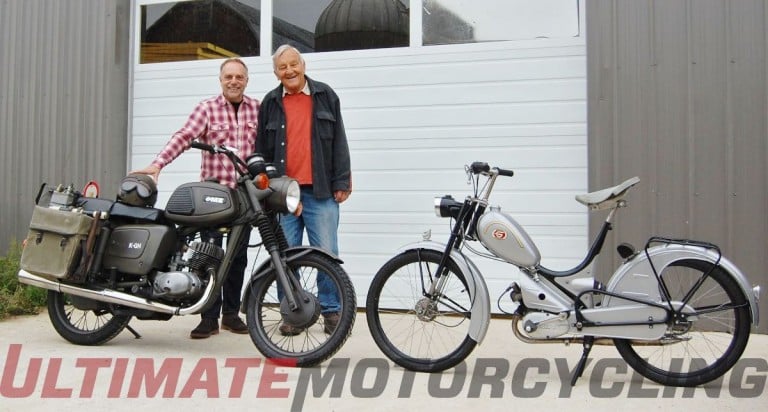
Peter Kisgen (L) presents rare examples of an MZ East German Military Police bike and Goricke Diva moped to Wisconsin collector, Carlo Krause.
Maschinenfabrik Zschopau (Machine Factory Zschopau; MZ) history goes back more than 100 years. In 1919, MZ developed the first two-stroke engine to be used on a bicycle.
In 1922, MZ built what is arguably the first motorcycle with a two-stroke engine and branded it DKW—Des Knaben Wunsch, which translates to The Boy’s Desire. Between 1922 and 1936, DKW motorcycles won 45 championships and Grand Prix races. By 1929, DKW was the world’s largest motorcycle manufacturer, producing 60,000 units annually.
1968 MZ ES 250 Trophy
During the 1960s, MZ motorcycles were one of the most successful brands in competition, winning the Six Day Trials Championships in 1963, 1964, 1965, 1966, 1967, 1969 while also celebrating numerous victories in road racing.
MZ motorcycle production flourished behind the Iron Curtain, reaching two million units (combined) by 1983. However, when the Berlin Wall came down, the MZ motorcycles were not competitive with their Japanese and Western European counterparts.
Between 1992 and 2008, MZ struggled through liquidations, ownership changes, and high production costs. In 2009, new ownership emerged, with former World Championship motorcycle racers Martin Wimmer involved in racing management.
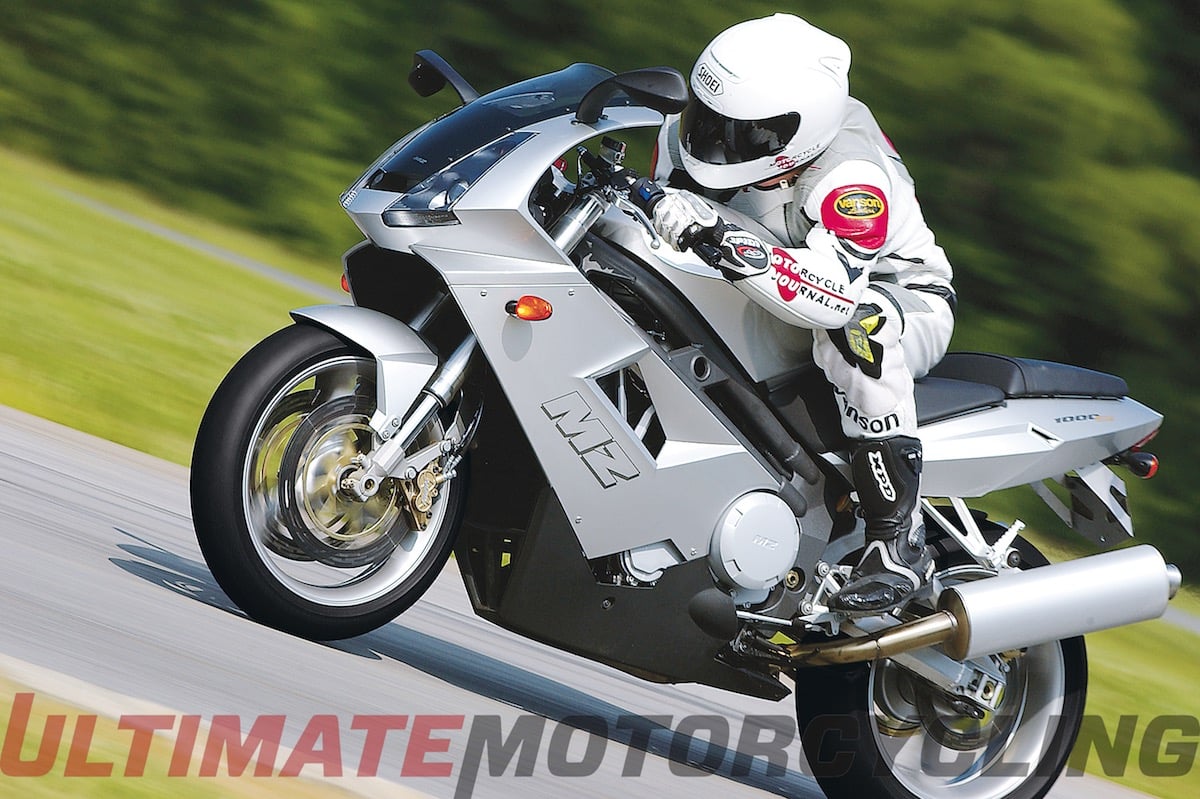
In 2010, MZ entered the Moto2 World Championship to prove that MZ is capable of building world-class motorcycles once again, and to introduce a new generation of motorcyclists to the MZ motorcycle brand.
MZ appears to be back. The MZ factory in Germany is busy preparing its third-generation Moto2 chassis, which will run the required Honda 600cc-spec engine, for the inaugural 2010 Moto2 season.
“In 1922, MZ built the first motorcycle with a two-stroke engine and branded it DKW. ”
On which planet did this happen??? MZ did not even exist until 1956!
DKW was mostly in WESTERN Germany after the war.
The DDR fascist government stole the DKW factory located in East Germany and renamed it IFA.
Do you even know what you are talking about???
MZ stared in 1906 as Maschinenfabrik Zschopau. We’ve rechecked the info and believe it to be accurate.
After World War II, the Zschopau factory, located in East Germany, was nationalized and became IFA, later renamed VEB Motorradwerk Zschopau (MZ) in 1956. DKW’s West German operations continued separately under Auto Union.
Have you ever wanted to ride a real MotoGP track? Well, here’s your chance! Leod Escapes does all sorts of amazing European tours, including the incredible Munich to Mugello tour at the end of June, or you can try the Core of Catalunya or the Portimão Andalusia trips, both in October. These are incredible touring experiences with the very best that Europe has to offer. Fabulous accommodation, incredible food, and motorcycles! So for the trip of a lifetime, visit LeodEscapes.com, now.
* * * * *
In our first segment, Don Williams and Nic de Sena chat about the latest Yamaha MT-07. The amazing motor in the Yamaha is mostly unchanged, however just about everything else with this bike has changed. Don and Nic have extensive experience riding this beast and you’ll hear both their likes and a couple of dislikes too.
* * * * *
Our guest for this episode is Nikolas Lazos, a 15-year old young man from Melbourne, Australia who starting racing in the Supersport 300 category in Australian Superbike last year. Nikolas had an awful crash at the tail end of last year that put him out of contention for the Championship. Teejay chats with Nikolas about his journey so far, and the physical and mental challenges he’s facing coming back from injury.
* * * * *
Here’s quick reminder to check out our monthly digital magazine. It’s filled with everything you want to read on motorcycling, including some things you’ve probably not seen elsewhere. It’s absolutely free and you will find it on the Apple App Store and of course on Google Play as well.
Don’t forget to leave us your comments on our social media—we’re on all the usual platforms at Ultimate Motorcycling. We love hearing your feedback… so good or bad, please let us know what you think. If there’s something you’d like us to cover, we’d love to hear those ideas too!
We use cookies and browser activity on this website
Functional
Always active
The technical storage or access is strictly necessary for the legitimate purpose of enabling the use of a specific service explicitly requested by the subscriber or user, or for the sole purpose of carrying out the transmission of a communication over an electronic communications network.
Preferences
The technical storage or access is necessary for the legitimate purpose of storing preferences that are not requested by the subscriber or user.
Statistics
The technical storage or access that is used exclusively for statistical purposes.The technical storage or access that is used exclusively for anonymous statistical purposes. Without a subpoena, voluntary compliance on the part of your Internet Service Provider, or additional records from a third party, information stored or retrieved for this purpose alone cannot usually be used to identify you.
Marketing
The technical storage or access is required to create user profiles to send advertising, or to track the user on a website or across several websites for similar marketing purposes.




“In 1922, MZ built the first motorcycle with a two-stroke engine and branded it DKW. ”
On which planet did this happen??? MZ did not even exist until 1956!
DKW was mostly in WESTERN Germany after the war.
The DDR fascist government stole the DKW factory located in East Germany and renamed it IFA.
Do you even know what you are talking about???
MZ stared in 1906 as Maschinenfabrik Zschopau. We’ve rechecked the info and believe it to be accurate.
After World War II, the Zschopau factory, located in East Germany, was nationalized and became IFA, later renamed VEB Motorradwerk Zschopau (MZ) in 1956. DKW’s West German operations continued separately under Auto Union.