


As the speeds of GP racing increased, and as more high-speed tracks were added to the season, it became apparent that the NS500 was reaching the end of its development cycle. By the early 1980s, more power was needed. Honda set out to create a machine with dominating performance, powered by a V4 engine with maximum horsepower.
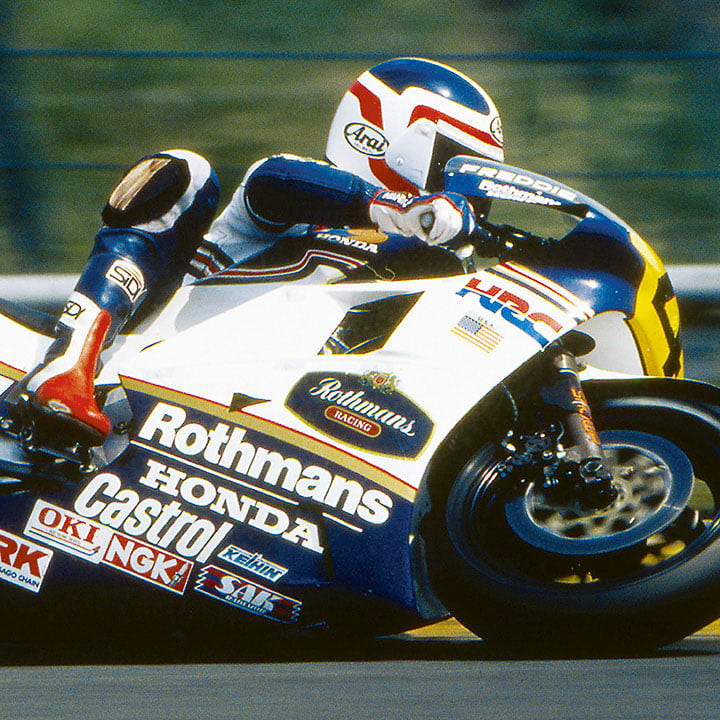
In contrast to the twin-crank, 90-degree, V4 rotary-valve engines of the competition, Honda was determined to produce a high-precision engine with high output at high rpm, all in a compact size. They accomplished this by developing a single-crank, 90° V4 with crankcase reed-valve induction. The new machine, with its simplified triple-shaft engine, was named the NSR500.
In its debut season of 1984, the new NSR featured an unusual design in which the fuel tank was mounted beneath the engine, with the expansion chambers running over the top of the engine. The increased width of the four-cylinder engine was compensated for by the lower center of gravity, resulting in highly responsive handling. The massive new twin-spar aluminum frame did away with under rails, instead gripping the engine between its branched side beams.
This unique construction had not been seen since the first NR500, and was an example of Honda’s continuing efforts to develop innovative technologies. However, once again, it was a case of too much too soon. The complex curves of the expansion chambers led to durability problems, and changing fuel loads adversely affected handling. After winning two races on the bike, Spencer switched to the NS500 in mid-season, ending the year in 4th place.
Still, the NSR500’s 150 peak horsepower put in the top level of machines for its era, so for 1985, a lightweight, high-rigidity RVF-style ‘Ultra Light Frame’ was designed. Built of large but lightweight triple-box-section aluminum extrusions, the frame delivered brilliant handling.

In parallel with the NSR500’s V4 engine, Honda also developed the NSR250, a 250cc V-twin that was essentially half a V4. Spencer would make GP history when he won both the 500cc and 250cc titles in the same year. From 1985 to 1993 Spencer’s two NSR racers would be painted in the Rothmans’ colors of the main sponsor. On the new NSRs, Spencer was blindingly fast.
During the 1985 season, Spencer won seven of twelve GPs, taking his second 500cc Championship and his first 250cc Title. Honda also took the Manufacturers’ titles in both classes. This was truly an epochal season for both HRC and Spencer.
Injuries prevented Spencer from completing the 1986 season, so Australian Wayne Gardner hopped on the NSR and fought the peaky, vibratory, and heavy-handling machine to a hard-won 2nd spot in the championship.
From this point onwards, engine development focused less on maximum power output and more on smoother, more linear power delivery. The days when maximum power and high top speeds were enough to win races were over. The 150 horsepower 2-stroke 500s had more than enough power for any rider. The new generation of race bikes would have to be more rider-friendly.
For 1987, the exhaust layout was changed, the cylinder V angle was increased to 112° and a primary balancer shaft was added to quell vibration, making it an entirely new 4-shaft engine. An ATAC exhaust valve was added (electronically controlled RC valves), significantly smoothing the bike’s power characteristics. Gardner took the title, winning seven of fifteen GPs and capturing the Manufacturers’ title for Honda once again.
Still, the chassis and the tires were now stretched beyond their limits by the powerful engine. So, for 1988, a new frame with an adjustable head pipe and improved suspension components was introduced. These upgrades helped Gardner win three races in a row at mid-season, but still left him in 2nd spot at year’s end.
An injury during the 1989 season led to Gardner being replaced by the 1988 world champ, Eddie Lawson, who had switched camps to Honda. In an effort to improve the NSR’s handling and traction characteristics, many new frames were tried during the season. Lawson won the title while avoiding a lot of new technology in the process.
A big surprise that arrived in 1990 was the advent of the Big Bang engine. In this configuration, the firing of each cylinder was offset 90 degrees, meaning that instead of each cylinder firing at 90-degree intervals, each set of two cylinders fired 180 degrees apart. The slight reduction in maximum power that resulted was more than offset by the improved torque characteristics caused by the increased amplitude in combustion torque waves. Traction during acceleration was markedly improved.
This was a major turning point in engine development, and the NSR’s engineers experimented with various firing orders and crank angle/ignition timing settings. As the bikes became easier to ride, lap times began to drop. Usable power became more important than maximum power. Chassis upgrades included such trick parts as expansion chambers and other parts made of titanium, helping to reduce machine weight by more than 15kg.
Around this time, another gifted rider appeared on the scene. Mick Doohan had been battling with Yamaha’s Wayne Rainey and Suzuki’s Kevin Schwantz, finishing 3rd in the championship in 1990 and 2nd in 1991. His time had now come.
By the time 1992 rolled around, a new 68° irregular firing order was being used. Each pair of cylinders fired simultaneously at 68° and 292° intervals. The resulting irregular combustion torque wave shapes delivered markedly superior traction. And just by chance, thanks to the crank phasing, the 112° V angle cancelled out the theoretical primary vibration, eliminating the need for a balancer shaft.
For the first time since 1986, this allowed a return to a triple-shaft engine, and a more rigid and precise engine structure. This new engine had a unique exhaust note, leading observers to call it a ‘screamer’ engine. In the bike’s first outing, the rain-sodden Japan GP, Mick Doohan rode the ‘screamer’ to victory. This win was especially impressive because before the screamer engine the NSR500 was difficult to ride in the wet.
Everyone expected Doohan to romp to the title in 1992, but his early-season win streak of five was cut cruelly short when he suffered a horrendous crash at the Dutch TT, resulting in severe injuries to his right leg. Still, the NSR500 won 7 of 13 GPs that year, amply proving its superiority. Though still not fully recovered for the 1993 season, Doohan did manage to win one race, ending up 4th in the championship. Daryl Beattie took the other win for the NSR500 in 1993. New technology introduced during the season included electronically controlled fuel injection that boosted output to more than 170 horsepower, allowing the NSR to clock an amazing 199 mph at the German GP.
For 1994, engine performance was further improved by a water injection system for the exhaust, which improved combustion chamber filling efficiency at low rpm. Electronically controlled damping for the rear suspension (Active Suspension) was also used. Even after Doohan regained his fitness, the aftereffects of the crash forced him to use a thumb-operated rear brake lever mounted on the left handlebar of his NSR.
The combination of the new NSR and a rejuvenated Doohan resulted in nine wins of fourteen races, an overwhelming performance that won Doohan the Riders’ title and Honda took the Manufacturers’ title. This was the start of a never-before-seen run of victories for the NSR500.
1995: 9 wins in 13 races / 7 wins for Mick Doohan
1996: 13 wins in 15 races / 8 wins for Doohan; NSR500V introduced
1997: 15 wins in all 15 events / 12 wins for Doohan
1998: 13 wins in 14 races / 8 wins for Doohan; 22 straight wins for Honda
1999: 9 wins in 16 races / Doohan retires; Alex Criville replaces him and wins the championship. Honda wins the Riders’ and Manufacturers’ titles in six consecutive years.
2001: 12 wins in 16 races/ 11 wins for Valentino Rossi / Honda achieves 500 wins in GP racing and again wins Riders’ and Manufacturers’ titles.
In 2002, the 500 GP class changed to MotoGP and 4-stroke engines, making it the last season for the NSR500. Now at the peak of its development, the NSR500 was cranking out an incredible 180 horsepower, allowing it to compete on almost level terms with the 200 horsepower 990cc MotoGP bikes. Still, the NSR500 never beat the RC211V, its best finish being a 2nd place.
However, the technology developed on the NSR500 made a huge contribution to the RC211V’s competitiveness. During the 19 years it was raced, no fundamental changes to the NSR500 were made. It won ten Riders’ Championships and nine Manufacturers’ titles, indisputable proof of the excellence of its design and technology.


Looking for an NSR 500 Honda For Sale Have Cash Money, in Canada for Shipping, Best Regards, Darren